
The EU AI Act is one of the most significant regulations shaping the safe and ethical use of artificial intelligence. This comprehensive legislation sets clear rules for the development, deployment, and governance of AI within the European Union. To prepare for compliance, organizations can leverage ISO 42001, the international standard for AI governance and risk management. By aligning with both the EU AI Act and ISO 42001, businesses can strengthen security, ensure ethical practices, and stay ahead in an evolving regulatory landscape. (more…)
Category: ISO 42001
Understand ISO 42001, the world’s first AI Management System standard. Learn how to implement an AIMS framework, manage AI risks like bias and transparency, integrate with ISO 27001, and prepare for certification and audit readiness.
-

Security Risks of AI, and How Does ISO 42001 Help?
AI security risks are a growing concern as businesses adopt artificial intelligence across operations. From data breaches and system vulnerabilities to regulatory and ethical challenges, organizations face multiple threats when implementing AI. The ISO 42001 standard helps mitigate these risks, providing a framework for stronger security, compliance, and responsible AI governance. (more…)
-
AI Risk Management and the ISO/IEC 42001 Framework
Organizations leveraging AI for automation and generative tasks need robust AI risk management, and that starts with ISO 42001. Implementing the ISO/IEC42001:2023 framework helps ensure your AI tools and systems are secure, compliant, and trustworthy for clients and partners. Wondering if your organization’s AI governance meets best practices? Request a consultation to assess your compliance today.
-

ISO 42001 and NIST AI RMF: The Perfect Partnership
From predictive algorithms driving healthcare innovation to generative AI transforming legal and financial services, artificial intelligence is evolving, and scaling, at unprecedented speed. Yet as adoption grows, many organizations struggle to align with consistent governance frameworks and risk management practices. Implementing an AI Management System (AIMS) built on ISO 42001 standards, alongside the NIST AI Risk Management Framework (AI RMF), provides a structured, accountable foundation for responsible AI operations. Together, these frameworks help organizations balance innovation with compliance, transparency, and trust in a rapidly advancing digital ecosystem.
-
What is the difference between ISO 42001 and ISO 27001?
Artificial intelligence (AI) and cybersecurity standards have rapidly reshaped the global compliance landscape. Two frameworks now lead this transformation: ISO 42001, the world’s first AI Management System (AIMS) standard, and ISO 27001, the internationally recognized benchmark for Information Security Management Systems (ISMS).
While both share the same ISO management-system structure, each framework targets a distinct, but increasingly interconnected, set of risks. As organizations adopt AI-driven technologies, leveraging ISO 42001 alongside ISO 27001 has become essential for managing emerging threats, meeting regulatory expectations, and maintaining digital trust in 2025 and beyond.
-
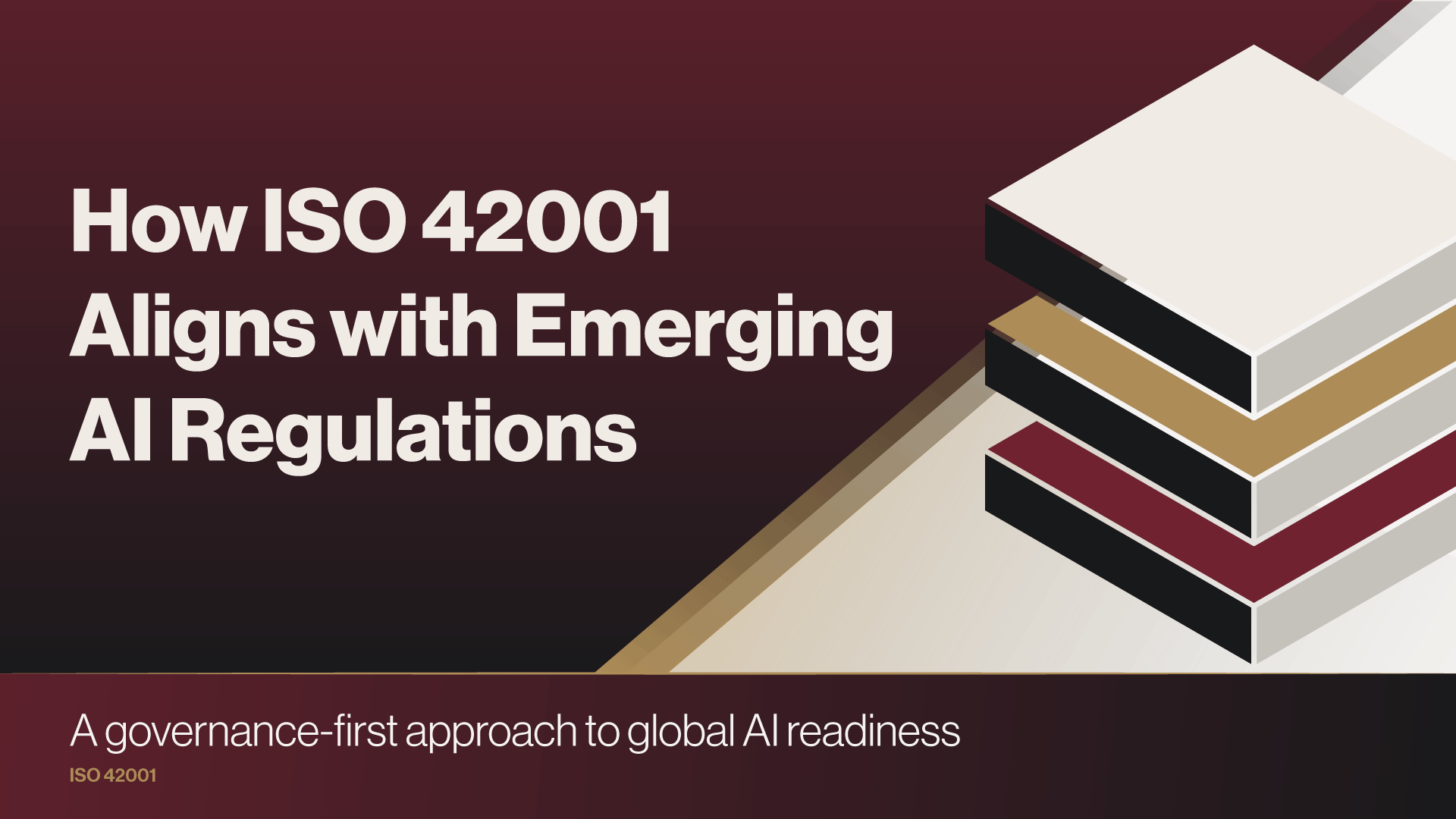
How ISO 42001 Aligns with Emerging AI Regulations
AI regulations are rapidly emerging worldwide as governments and regulators respond to the growing use of artificial intelligence across business operations. Organizations leveraging AI for productivity, automation, and decision-making will soon be expected to meet clear governance, risk, and accountability requirements.
While individual AI regulations differ by region, most share common themes, such as transparency, risk management, human oversight, and documented controls. ISO/IEC 42001, the international standard for AI management systems, is designed around these same principles, making it a practical foundation for regulatory alignment.
Is your organization prepared to navigate the evolving regulations and governance expectations surrounding AI?
An ISO 42001,aligned approach helps organizations structure AI risk management, strengthen oversight, and demonstrate regulatory readiness as global AI regulations continue to take shape.
-

AWS AI Threat Modeling Guidance
AI threat modeling is a proactive security practice that helps organizations identify, evaluate, and mitigate risks created by artificial intelligence systems, especially in dynamic cloud environments like AWS. As AI becomes embedded in workflows, applications, and automated decision-making, traditional threat modeling alone is no longer enough. Modern approaches now use AI-driven techniques to increase the accuracy, speed, and coverage of threat detection.
If your organization is deploying AI tools, machine learning models, or automation pipelines in AWS, now is the time to strengthen your security posture. (more…)
-
What is ISO 42001?
Artificial intelligence (AI) is no longer on the horizon; it’s transforming how organizations operate, innovate, and compete. But with these powerful capabilities come significant risks, including bias, lack of transparency, and emerging security threats. ISO 42001 (ISO/IEC 42001:2023) was developed to tackle these risks directly. As the world’s first international standard for AI Management Systems (AIMS), ISO 42001 provides a certifiable framework to help organizations govern AI responsibly, ethically, and securely across industries.
(more…)
-

How to Leverage a vCISO for ISO 42001 Compliance
Leveraging a vCISO for ISO 42001 compliance is becoming essential as artificial intelligence (AI) transforms industries through smarter decision-making, automation, and innovation. Yet, as AI systems grow in complexity, so do the risks they introduce.
ISO 42001 compliance provides a structured framework for responsible AI governance, helping organizations manage risks, strengthen security, and ensure ethical deployment across their operations.
-

Preparing for Your ISO 42001 Audit: A Practical Guide for AI Governance Readiness
Audits often bring to mind tight deadlines, disorganized documentation, and unclear expectations. However, with the right preparation, an ISO 42001 audit can become a strategic opportunity to validate your AI governance program and build stakeholder trust.
An ISO 42001 audit evaluates the effectiveness of your AI Management System (AIMS), with a focus on responsible AI use, risk management, leadership involvement, and operational maturity. In most cases, audit challenges arise not from the standard itself, but from misaligned roles, incomplete documentation, or poorly defined controls.
This guide explains how to prepare for an ISO 42001 audit effectively, covering required documentation, internal reviews, operational controls, and cross-functional alignment, so you can approach ISO 42001 certification with confidence.  (more…)