Category: Compliance Standards

Staying informed about all of the cyber security compliance standards is essential to keeping your company safe from hackers. Read on to learn about the various steps you can take to stay up to date with your industry’s compliance standards.

  • NIST AI Risk Management Framework to ISO-IEC-42001 Crosswalk

    NIST AI Risk Management Framework to ISO-IEC-42001 Crosswalk

    Organizations implementing AI technologies must stay ahead of rapidly emerging governance and compliance requirements. Two of the most important frameworks are the NIST AI Risk Management Framework (NIST AI RMF) in the United States and the ISO/IEC 42001:2023 AI Management System standard used internationally. While each framework- serves a different regulatory environment, starting with the NIST AI Risk Management Framework provides a strong foundation that makes aligning with—and ultimately certifying against, ISO 42001 significantly easier.

    Is your organization preparing for NIST or ISO AI compliance? Schedule a consultation to get expert guidance.
     

    (more…)

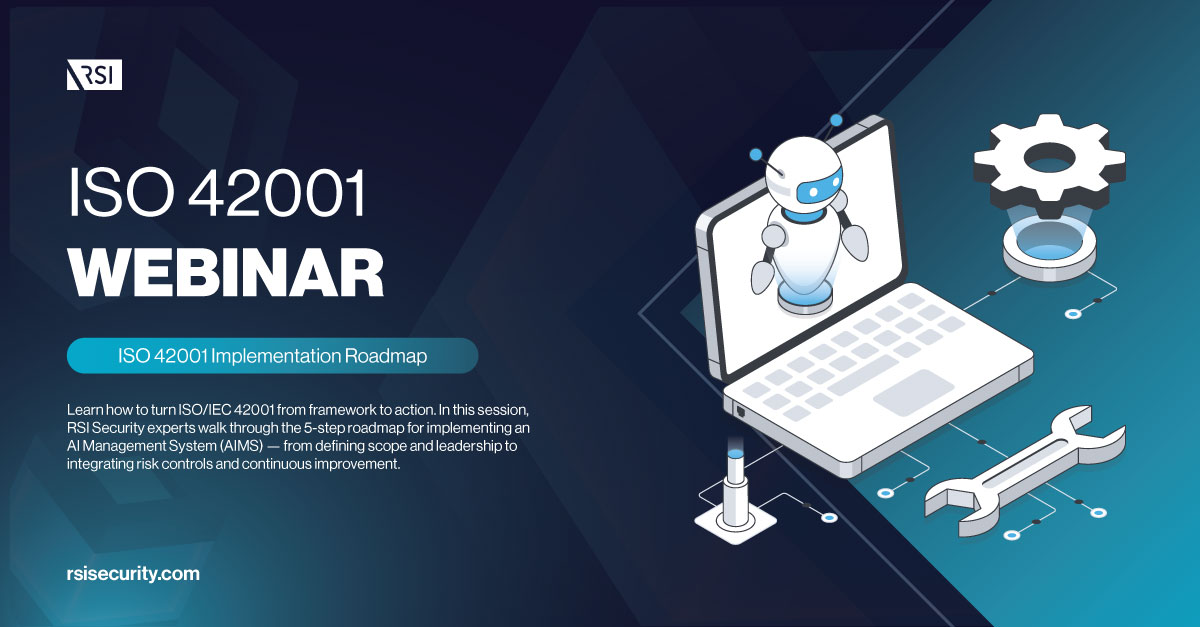
  • ISO/IEC 42001 Webinar Recap: How to Implement Your AI Management System (AIMS)

    ISO/IEC 42001 Webinar Recap: How to Implement Your AI Management System (AIMS)

    Over the past three weeks, our ISO/IEC 42001 webinar series has laid the groundwork for responsible and scalable AI management system. We explored what ISO 42001 entails, how it aligns with the NIST AI Risk Management Framework, and its integration with existing programs like ISO 27001 and GDPR.

    In this final session, we shifted from understanding why AI governance is essential to actionable implementation. Below is a detailed recap of our discussion, designed to guide teams in transforming awareness into practice and starting to build a functional, auditable AI management system (AIMS). (more…)

  • How San José Is Using the NIST AI RMF to Build Trustworthy AI

    How San José Is Using the NIST AI RMF to Build Trustworthy AI

    As artificial intelligence (AI) becomes increasingly embedded in government operations, cities across the U.S. face a critical challenge: ensuring these systems remain fair, safe, transparent, and trustworthy. The City of San José, California, one of the country’s leading technology hubs, has emerged as an early model for responsible public-sector AI. San José is one of the first municipalities to formally evaluate its AI programs using the NIST AI Risk Management Framework (AI RMF). Through a collaboration with the National Institute of Standards and Technology, the city applied the AI RMF to assess its AI governance maturity, identify risks, and strengthen safeguards across all AI-related activities.

    This NIST AI RMF case study reveals not only what San José is doing well, but also where public-sector organizations must continue improving to deploy trustworthy, risk-aware AI systems. (more…)

  • Generative Artificial Intelligence Risk & NIST AI RMF

    Generative Artificial Intelligence Risk & NIST AI RMF

    Generative Artificial Intelligence offers organizations across industries significant productivity and efficiency gains, but it also introduces new risks. The NIST AI RMF (AI Risk Management Framework) provides a structured approach to identify, assess, and mitigate these risks while maximizing the benefits of generative AI.
    Is your organization prepared for secure and compliant AI adoption? Schedule a consultation today to ensure your AI initiatives are safe, responsible, and aligned with industry standards.

    (more…)

  • Roadmap to Achieving NIST AI RMF

    Roadmap to Achieving NIST AI RMF

    Organizations embracing artificial intelligence (AI) to streamline operations must also prepare for the unique risks it. The NIST AI Risk Management Framework (AI RMF) provides a structured, trustworthy approach to identifying, evaluating, and mitigating these risks across the AI lifecycle. Implementing this framework helps internal teams establish clear governance and gives external stakeholders confidence in your organization’s responsible AI practices.

    Is your organization ready to align with the NIST AI Risk Management Framework? Schedule a consultation to get started.


    (more…)

  • 10 Common Questions About SOC 2 Compliance

    10 Common Questions About SOC 2 Compliance

    SOC 2 Compliance is a critical standard for service-oriented businesses aiming to protect client data and build trust. Developed by the American Institute of CPAs (AICPA), SOC 2 provides a framework for managing and securing sensitive information. While achieving SOC 2 compliance can seem complex, understanding its requirements is essential for safeguarding data, meeting client expectations, and demonstrating a strong commitment to cybersecurity.

    (more…)

  • Who Needs to be SOC 2 Compliant?

    Who Needs to be SOC 2 Compliant?

    Depending on your business and the type of data you handle, you may need to be SOC 2 compliant to meet the security standards set by the American Institute of CPAs (AICPA). SOC reports, SOC 1, SOC 2, and SOC 3, apply mainly to service organizations that store, process, or manage customer data.

    So, who exactly needs to be SOC 2 compliant, and what does SOC 2 cover? Keep reading to find out everything you need to know about SOC 2 compliance and how it protects sensitive data

    (more…)

  • What are the SOC 2 Controls?

    What are the SOC 2 Controls?

    Service organizations pursue SOC reports to demonstrate to clients that their data is handled securely. SOC 2 reports specifically assess a company’s adherence to the five Trust Services Criteria (TSC): security, availability, processing integrity, confidentiality, and privacy. These criteria, established by the American Institute of Certified Public Accountants (AICPA), form the foundation for SOC 2 controls that guide audit and reporting processes. Unlike a simple checklist, the TSC provides a framework that ensures organizations implement effective controls to protect client data.
    (more…)

  • AI Attack Vectors: How Intelligent Threats Are Redefining Cybersecurity Defense

    AI Attack Vectors: How Intelligent Threats Are Redefining Cybersecurity Defense

    The digital arms race is accelerating, and artificial intelligence (AI) is becoming both a weapon and a target. As AI systems increasingly interact, a new generation of attack vectors is emerging, where one intelligent system exploits another’s weaknesses at machine speed.

    These aren’t theoretical threats. From prompt injection to feedback loop manipulation, malicious AI systems are already probing and exploiting vulnerabilities in other AIs. Understanding these attack vectors is critical to defending the next wave of intelligent infrastructure and maintaining trust in automated decision-making.

    (more…)

  • A Strategic playbook Guide to Responsible AI Risk Management

    A Strategic playbook Guide to Responsible AI Risk Management

    Artificial Intelligence (AI) is transforming industries worldwide, from healthcare and finance to manufacturing and national security. However, with these opportunities come significant challenges such as bias, data privacy concerns, regulatory noncompliance, and potential system failures. The NIST AI RMF Playbook provides organizations with a structured approach to managing these AI risks responsibly and promoting trustworthy innovation.

    To address these risks, the National Institute of Standards and Technology (NIST) introduced the NIST AI RMF Playbook, a strategic framework that helps organizations identify, assess, and manage AI-related risks responsibly. This guide promotes ethical, transparent, and secure AI adoption across sectors.

    In this blog, we’ll explore what the NIST AI RMF Playbook is, how it’s structured, and why it’s becoming the go-to resource for building trustworthy and compliant AI systems.

    (more…)